How to Choose the Right Business Activity for Your UAE Trade Licence
Learn how UAE business activities affect licence type, legal form, jurisdiction, approvals, premises, visas and commercial operations.
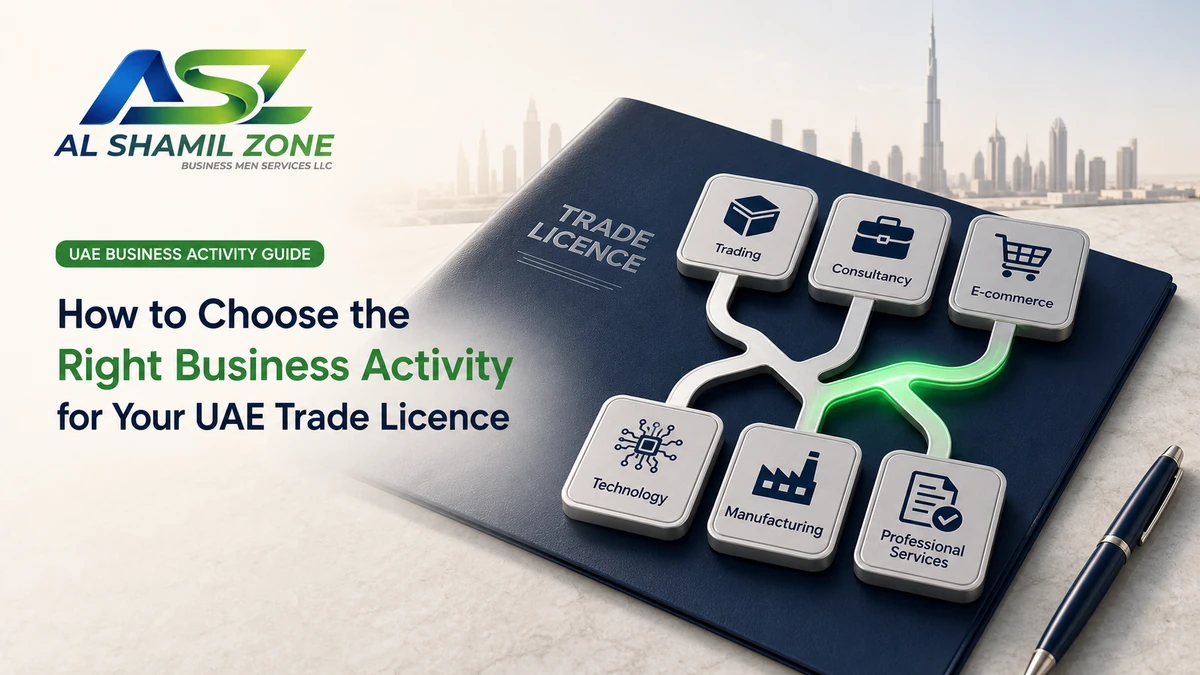
Choosing a business activity is one of the most important decisions in UAE company formation. The activity defines what the company is authorised to do and can influence the licence type, legal form, jurisdiction, premises, external approvals, visa planning and ongoing compliance.
The safest choice is not necessarily the broadest or cheapest activity on a setup package. It is the activity—or permitted combination of activities—that accurately describes how the business will earn revenue and operate in practice.
What is a business activity?
A business activity is the official description and code assigned by a licensing authority to a type of commercial, professional, industrial or other economic operation.
Examples include management consultancy, software development, foodstuff trading, e-commerce, marketing services, equipment rental and manufacturing. Similar everyday descriptions can map to different official activities, each with its own permitted scope.
The UAE Government states that activity selection is the basis for choosing the legal form and licence type, and that businesses can select from more than 2,000 economic activities. Its official Mainland business setup guidance explains this relationship.
Start with the real revenue model
Before searching an activity list, describe the business in plain language:
- What exactly will the company sell?
- Are customers paying for goods, advice, access, subscriptions, commissions, production or labour?
- Will the company own stock or only arrange transactions?
- Will it import, export or sell within the UAE?
- Will services be delivered online, at a client's site or from licensed premises?
- Are customers businesses, consumers, government entities or a mixture?
- Will the company employ qualified professionals?
- Does it handle regulated products, funds, personal data, food, health, education or transport?
This description makes it easier to distinguish between activities that sound similar but authorise different operations.
Common licence and activity families
| Activity family | Typical business model | Questions to check |
|---|---|---|
| Commercial or trading | Buying, selling, importing, exporting or distributing specified goods | Which products? Is general trading available? Are any goods regulated? |
| Professional or consultancy | Advice, expertise or specialist services | Does the activity allow implementation as well as advice? Are qualifications required? |
| E-commerce | Selling goods or services through digital channels | What is being sold? Is e-commerce a channel in addition to an underlying activity? |
| Technology | Software, platforms, IT services, data or related solutions | Is the company developing, licensing, operating or consulting? |
| Industrial or manufacturing | Producing, assembling, processing or packaging goods | What facility, environmental and industrial approvals are required? |
| Media and creative | Advertising, content, publishing, production or design | Does the work require a media permit or content-related approval? |
| Tourism and hospitality | Travel, accommodation, events or visitor services | Which tourism authority and operational approvals apply? |
Trading versus services
A service activity does not normally authorise a company to purchase and resell goods as its own inventory. Similarly, a trading activity may not cover professional advice, installation, maintenance or technical services unless those activities are included.
Consider the full customer contract. If the business sells equipment and also installs or maintains it, the licence may need both the relevant trading and service activities.
Consultancy versus operational services
Consultancy usually means providing analysis, recommendations or specialist advice. An operational service means performing or managing the actual work.
For example, a marketing consultancy activity may not provide the same scope as advertising campaign management, media buying, social-media management or content production. Do not choose “consultancy” merely because it appears flexible.
E-commerce is a sales channel
E-commerce describes how transactions occur, but the authority may still need to know what the company sells. An online shop selling cosmetics, an online learning platform and a software subscription business have different products, risks and possible approvals.
Check whether the jurisdiction requires an e-commerce activity alone, an underlying trading or service activity, or a permitted combination.
General trading versus specific trading
General trading can allow a broader range of permitted goods, but it may cost more, carry additional conditions or exclude regulated products. A specific trading activity can be more economical and clearer for banking and supplier onboarding when the product range is focused.
Neither option authorises prohibited or specially regulated goods without the required approvals. Food, pharmaceuticals, medical devices, precious metals, chemicals, telecommunications equipment and other categories can have additional rules.
Can one licence include several activities?
The UAE permits more than one economic activity on a licence in many circumstances, but combination rules differ by authority. Some activities can be grouped under one licence, while others require a separate licence, branch, legal form or approval.
Before combining activities, confirm:
- that the authority allows the combination;
- whether they fall under compatible licence types;
- whether additional activity fees apply;
- whether one activity changes the required premises;
- whether external approval is required for any activity;
- whether the legal form supports all selected activities; and
- whether the business name and memorandum remain appropriate.
Adding unrelated activities “just in case” can make the business model harder to explain to banks, insurers, regulators and customers.
How activity affects Mainland versus Free Zone selection
Mainland and Free Zone authorities maintain their own activity lists, descriptions and combination rules. Two activities with similar names can have different scopes across jurisdictions.
Mainland may suit a business when:
- its operations, premises or regulated approvals are closely connected to a local emirate;
- it needs an activity available through the relevant economic department;
- it plans broad local contracting or physical operations; or
- the preferred legal form and location are supported.
A Free Zone may suit a business when:
- the authority specialises in or clearly supports the proposed activity;
- the selected package, facility and visa allocation match the operating plan;
- the company understands how it will transact within and outside the zone; and
- the activity wording is acceptable to clients, banks and other stakeholders.
Do not choose a jurisdiction first and force the business into the nearest available activity. Compare both the activity scope and the full operational requirements.
How activity affects legal form
The legal form must be compatible with the economic activity. A sole establishment, civil company, limited liability company, branch or Free Zone entity has different ownership, liability and governance features.
The Ministry of Economy and Tourism explains that the nature of the activity defines the licence type and helps determine the legal form. Review both decisions together rather than treating the entity type as a separate administrative choice.
External approvals
Certain activities require approval from a federal, emirate-level or sector authority in addition to the economic licence. Examples can include:
- healthcare and medical services;
- education and training;
- food production and food service;
- tourism and travel;
- transport and vehicle-related services;
- financial services, payments, insurance and investment activities;
- recruitment and manpower supply;
- telecommunications;
- industrial and environmental activities;
- legal and audit services; and
- media, publishing and certain advertising activities.
An initial economic approval does not necessarily mean the company can begin the regulated activity before all sector conditions are satisfied.
Premises and facility requirements
Activity selection can determine whether the company may use a desk package, needs a conventional office, requires a warehouse or must operate from specially approved premises.
A manufacturing, clinic, restaurant, nursery or vehicle workshop cannot be planned like a remote consultancy. Check zoning, size, inspection, safety and fit-out requirements before signing a long lease.
Activity and visa planning
The licence activity and facility package can affect establishment registration and visa allocation. It can also influence whether employee occupations appear consistent with the business.
UAE labour guidance notes that an employee's occupation should align with the establishment's business activity. A technology company requesting unrelated specialist job titles may receive additional questions.
Activity and bank account opening
Banks assess the nature and purpose of the company, expected transactions, customers, suppliers and jurisdictions. A clearly selected activity helps the bank understand the business, but does not guarantee account approval.
Problems arise when contracts and invoices describe operations outside the licence, or when a very broad licence is supported by a vague business plan. The activity, website, company profile and bank application should tell the same commercial story.
Activity and tax treatment
The trade licence activity is relevant context but does not alone determine VAT or corporate tax treatment. Tax depends on the actual transactions, legal person, jurisdiction, income and applicable legislation.
A company should not assume that selecting “consultancy,” “e-commerce” or a Free Zone activity automatically creates a particular tax result. Obtain tax advice based on what the company really does.
Activity-selection framework
| Question | Why it matters |
|---|---|
| What will appear on customer invoices? | The activity must cover the actual source of revenue. |
| Will the company sell goods, services or both? | Trading and service permissions differ. |
| Where and how will delivery occur? | Premises, local operations and jurisdiction may be affected. |
| Who regulates the product or profession? | External approval may be required before operation. |
| Which legal form is appropriate? | The form must be compatible with the selected activity. |
| Which employees and visas are needed? | Occupations and allocation should support operations. |
| Can the activities be combined? | Some combinations require extra fees or separate licences. |
| How will banks and clients understand the company? | Clear activity wording supports commercial credibility. |
Common activity-selection mistakes
- choosing the cheapest activity without reading its scope;
- selecting consultancy when the company will perform operational work;
- assuming e-commerce covers every product or service sold online;
- using a service licence to trade physical goods;
- adding general trading without understanding cost and restrictions;
- ignoring external regulator approval;
- choosing a Free Zone before confirming the exact activity exists there;
- combining incompatible activities;
- signing premises before checking zoning and facility conditions;
- copying a competitor's licence description without comparing the business model; and
- operating beyond the licensed scope after launch.
How to verify an activity
- Write a clear description of products, services, customers and revenue.
- Search the official activity database for the proposed emirate or Free Zone.
- Read the activity description and restrictions, not only its title.
- Confirm compatible legal forms and activity combinations.
- Identify every external approval and responsible authority.
- Check premises, facility, capital and qualification requirements.
- Confirm fees, visa allocation and renewal obligations.
- Obtain written clarification for any uncertain scope before paying.
Dubai investors can use the official Invest in Dubai activity search to look up activity names and codes. Other emirates and Free Zones provide their own official lists and enquiry channels.
Choose an activity that fits the business
Al Shamil Zone Business Men Services can compare activity descriptions across suitable Mainland and Free Zone jurisdictions, identify likely external approvals and prepare a setup structure aligned with the company's real operations.
Need help selecting the right activity? Call +971 4 408 1900, contact us through WhatsApp at +971 50 777 5554, or email info@shamilservices.ae.
This article provides general information and is not legal or regulatory advice. Activity names, scopes, combinations, fees and approvals differ by licensing authority and can change. Confirm the exact activity in writing with the responsible authority before incorporation.
Ready to get started? Contact Al Shamil Zone by phone at 800 2794, via WhatsApp at +971 54 586 6222, or email info@shamilservices.ae.